
Introduction
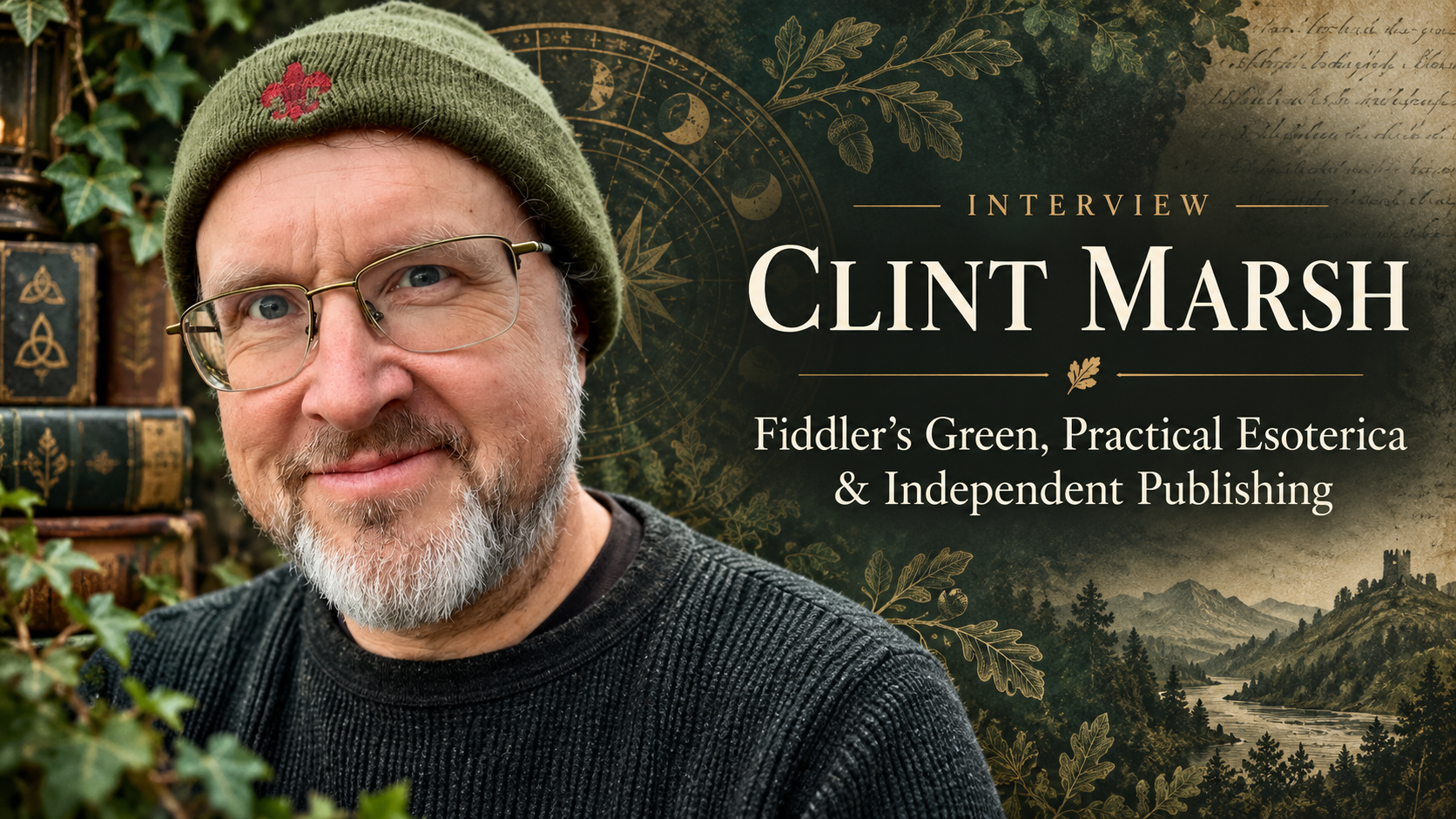
Clint Marsh is the writer and publisher behind Fiddler’s Green Peculiar Parish Magazine, a publication exploring magic, folklore, art, and independent publishing. His approach to what he calls “practical esoterica” runs throughout this interview, alongside his long involvement in zines and small-press publishing.
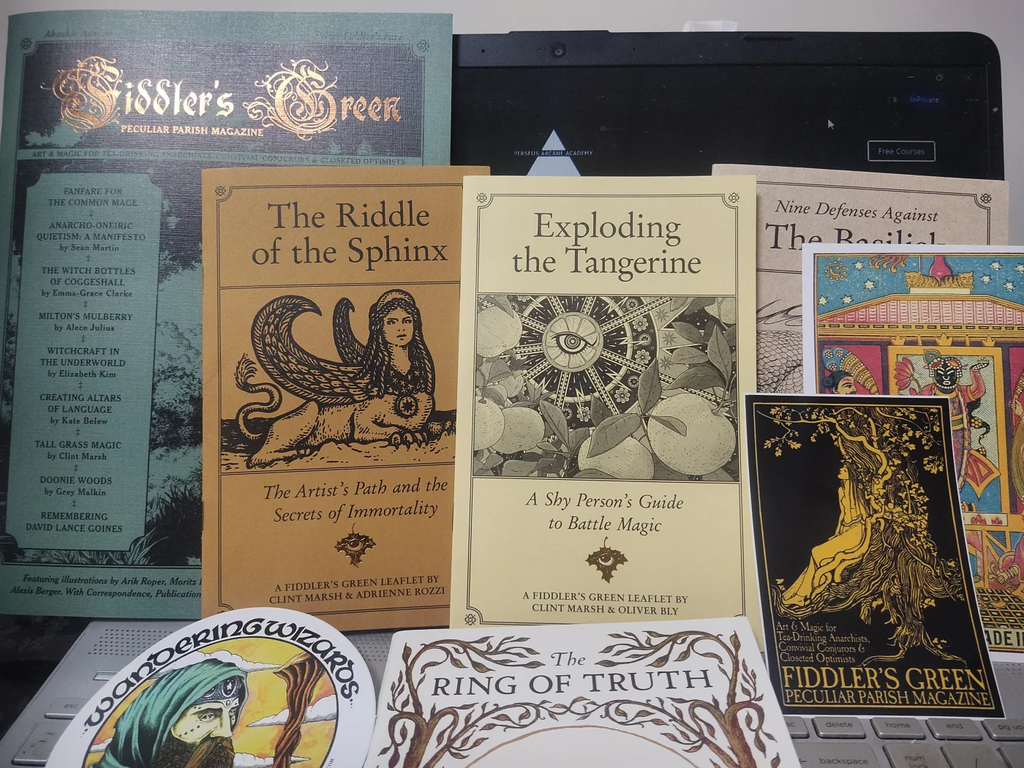
I want to say a huge thank you to Clint for very kindly offering to send me a package all the way out here to Asia. It arrived packed with lots of goodies, as you can see in the image below. It was a wonderful package to receive and very much appreciated.
There is something especially fitting about encountering Fiddler’s Green this way — as a beautifully put-together physical object rather than just another thing on a screen. These are quality publications, from the paper and foil used to the artwork and design, and the writing inside is even better.
Huge thanks to Clint for his generosity.
An Interview with Clint Marsh
Early Encounters and Personal Practice
PAA: What were your first real encounters with the occult—specific books, experiences, or moments— and when did it shift from fascination to lived conviction for you?
Thank you for the opportunity to talk about my history with the occult. For me, it’s been nearly a lifelong interest. When I was six years old, my family moved house and ended up acquiring some of the previous owner’s belongings, among them a bookcase full of volumes on esoteric subjects. The titles I remember
from that time are the illustrated ones, including The Egyptian Book of the Dead, The Malleus Maleficarum, and Grillot de Givry’s Anthology of Magic, Witchcraft, and Alchemy. I was just learning how to read, and the pictures captivated my attention. This would have been the winter of 1980–1981. I spent a few years revisiting each of the books and making new discoveries, supplementing my imagination with the abundant supply of pop culture occult fantasy available at the time from television, the library, and the local comic book store.
I wasn’t the only person whose imagination was sparked by the books. The Satanic Panic was in full swing at the time, and due to its influence my parents eventually moved the books along to new homes and away from my curious and impressionable eyes. The de Givry volume was the last to go, and I’m glad for it, as it was the most varied in the subject material covered, had hundreds of great illustrations, and was written with a wicked sense of humor.
My time with the books at home sparked my fascination, and after they were gone I kept the fire burning with the aforementioned pop fantasy, mostly via comic books and Dungeons & Dragons. When I was sixteen years old, a girlfriend introduced me to Wicca. This helped me realize that the magical practices that, up until that point, seemed to live only in the past or in fiction were in fact alive and well, ready for my involvement. This led me to take up my own idiosyncratic magical practice and devote myself to esoteric studies and, eventually, writing.
I would say that my magical practice is one of observation, integration, and prayer.
Clint Marsh
PAA: How would you describe your current magical practice? Are there particular disciplines, rituals, or habits that remain non-negotiable regardless of circumstance? Also, what if anything have you dropped and deemed unnecessary?
My magical practice has never been particularly formal or consistent. I can rightfully be called a dabbler, or even a mere occultist rather than a practitioner. But my understanding of other people’s practices and systems has informed my reality in ways that I believe make my life a magical one, and that’s good enough for me.
I would say that my magical practice is one of observation, integration, and prayer. I keep my eyes open for synchronicity, coincidence, and layered meaning. Growing up a sarcastic and cynical Gen-X kid has made me appreciate irony, and I think it’s possible to cultivate a positive thoughtfulness from that. I look for patterns or correspondences and imbue them with personal meaning. This helps me find hope in life and beauty in the world around me. On some days it comes more easily than on others! But overall, it’s a positive magic. I love being swept away by beauty in music and visual art. Sometimes this comes through in dark ways, as through metal music or gothic art. The beauty is still there. It’s a Romantic sort of magic, I suppose. Another way I integrate magical meaning is to talk to others about my understanding of reality. This could be in conversation or through my writing. For the past decade or so I’ve been publishing Fiddler’s Green Peculiar Parish Magazine, which is dedicated specifically to this type of magical discussion. Prayer would be the third pillar of magic in my life—prayer and reading. I think of both of these practices as ways to put myself in touch with the spiritual world, often leading me to further insights or at least to the comforting realization that I’m not alone in my seemingly odd and analytical way of looking at the world.
If there’s anything I could say I’ve dropped or deemed unnecessary, it would be the need to find community in formal magical or esoteric organizations. I don’t have the right temperament for that kind of focus, and I certainly don’t like dogma or anything that leads to rigidity of thought or belief.
PAA: You’ve written about magic as rooted in the human experience of life—how do you personally define “magic” in practical terms, and what distinguishes a working that truly functions from one that is merely symbolic?
Broadly speaking, I believe symbols exert so much power over people that it’s impossible to speak of the human experience without the involvement of symbols and symbolism. I’m including, in my definition of symbols, everything from language and imagery to ideals such as love, pride, and affinity among those who share a religious or national identity, among other affiliations. These symbols can lead people to do good or ill in the world, and even that is highly subjective, but I believe people are driven by their personal identification with any number of symbols. Even the prices put on goods and services are symbolic, as is their value, and we grapple with these intangible realities daily.
I can’t remember when I first read Ramsey Dukes’ definition of magic as one of four ways that people interact with reality—the others being art, science, and religion—but it makes sense to me. One doesn’t have to choose a single modality from the four at the expense of the others, but I’d imagine any given person favors one or two. The tagline on the cover of every issue of Fiddler’s Green is “Art and Magic for Tea-Drinking Anarchists, Convivial Conjurors, and Closeted Optimists.” I chose to lean into the art and magic modalities with this project because they are my favored lenses for looking at the world. In answer to your question, though, I believe that when someone views life from the magical modality, then magic will happen naturally for them. If they are aware of their bias, then they have the opportunity to witness the magic and learn and change from it, even if other people can’t. Thanks to this kind of interpretation, everything has the potential to function magically. Nothing is purely symbolic.
I’ve always tried to write what I call “practical esoterica,” which is a phrase that makes non-magically minded people chuckle but is understood immediately by the right kind of reader.
Clint Marsh
PAA: Your essays often translate psychological states into mythic language—like anxiety as a basilisk or confidence as battle magic. How does that process work internally for you? Do the metaphors arise first, or the lived experience?
Ideally, the lived experience happens first. This type of writing started taking shape for me when I was doing daily blogging for the shop Castle in the Air here in Berkeley. It was an art shop and mail-order art supply business that recognized the value and often fragile state of a person’s imagination. Karima Cammell and I would write about something happening at the shop, but because we had a readership that was largely elsewhere—not in Berkeley—we tried to include in each post something that would apply universally to anyone willing to use their imagination. Our most triumphant example, I believe, was tying the urge to dive into one’s artistic practice with the myth of Icarus and Daedalus, comparing the courage to make a creative leap with this story of two men who used their ingenuity and self-governance (or lack thereof) to do something no one had done before.
For years I’d wanted to write something about the basilisk, the fearsome mythical creature that turned anyone who returned its gaze to stone. I thought it was a fascinating type of monster and just wanted to collect the legends and trivia about the basilisk into a single booklet. I was probably inspired in this by Ed Greenwood’s “The Ecology of the…” column in Dragon Magazine, where he would take a deep dive into the legends and minutia of a single monster in D&D. I found a lot about the basilisk in the writings of Pliny and other philosophers, but I was wrestling with how to make my writing more than just a collection of trivia. I’ve always tried to write what I call “practical esoterica,” which is a phrase that makes non-magically minded people chuckle but is understood immediately by the right kind of reader. As the basilisk text came together, I conceded to myself that there probably wasn’t anyone who would read it who’d actually faced down a basilisk (and lived to tell the tale), nor would any of us likely have to do that later in life. But I was intrigued by the different means by which warriors would prepare to meet the basilisk. The mirror—à la Perseus, fittingly—was a classic defense, but so was a weasel? There was real variety in the defenses. Around this same time, I was going through a period of extreme anxiety and self-doubt in the rest of my life, and I didn’t know what to do to get out of this situation. I was delaying making any necessary changes, and it felt like I was in danger of turning to stone, metaphorically of course. At some point it clicked for me that this could be what the myth of the basilisk was trying to tell me, that the monstrous creature exists and that, while it can be tricky to do, there are ways to avoid its petrifying gaze. As I finished writing the essay, I had a better understanding of the type of practical esoterica I would eventually present in Fiddler’s Green, the publication that was taking shape in my imagination around the same time.
Early Publishing and Evolution of Voice
PAA: In Phooka, writing as Reginald Bakeley allowed you to approach folklore through irony and persona. What changed in you that made it possible to drop the mask and write directly, as you do in Fiddler’s Green?
I created the persona of Reginald Bakeley in 1997, first publishing something under that name in my zine series Jacaré. Similarly to the origins of the basilisk essay, I wanted to write something on gnome folklore. I’d grown up with Huygen and Poortvliet’s Gnomes, captivated by the book’s artwork and first person, matter-of-fact accounts of these diminutive creatures of Scandinavian lore. My cynicism was strong as a teen and young adult, but I think it was a defense or shield for my heart, which yearned to have experiences with the creatures and concepts of folklore and legend. I longed for something bigger than the little world I was growing up in in Iowa. Gnomes seemed to provide the doorway out, detailing the lives and habits of gnomes and trolls, and I relished it. I came to understand, though, that wonder is a fragile thing, that it works best if kept at arm’s length, allowing our imaginations to fill in the blanks. It must have been the page in Gnomes where Poortvliet had painted an elaborate picture of the gnomes’ family toilet that broke the spell for me. I’d wanted to learn about the gnomes and their lives, but now I knew too much! I wanted to think of them in terms of how they might fit into the environmental and cultural ecosystems of the Scandinavian peoples, but I didn’t want to think of how they might run out of toilet paper.
Out of this disappointment over the glut of information, Reginald Bakeley was born. I thought of him as a folklorist and writer like the authors of Gnomes, but one who didn’t want the second sight, the ability to see them and be in their world. Reginald was my disgust made manifest. He lived among the gnomes—and goblins and trolls and eventually mermaids and other fabulous beasts—but he was upset over it. He just wanted to live his life. I imagined Reginald as a gentleman farmer who owned a country estate in Wales. He hunted, fished, and raised livestock, and he played croquet professionally. But he was plagued by clairvoyance and was constantly getting into trouble with the fairy kingdom, or perhaps it’s more accurate to say that the fairy kingdom was in trouble with Reginald Bakeley. His most popular essay, which I eventually published as a pamphlet, is one called “On Gnoming: A Pocket Guide to the Successful Hunting and Cooking of Gnomes.” I wrote a handful of Bakeley essays in a zine series I published in 1998 called Phooka. These essays went on to have a life of their own as individual pamphlets (the precursor to my current Fiddler’s Green Leaflets series) and, in 2012, a collection of these plus some new writings was published by an imprint of Weiser Books as Goblinproofing One’s Chicken Coop: Practical Advice in Our Campaign Against the Fairy Kingdom.
It was right around the time of Goblinproofing’s publication that I’d nearly outgrown the need for a filter for my interest in folklore and the esoteric. After Phooka, I’d gone on to publish The Camelopard Series, a set of half a dozen zines on Victorian-style psychic development that was collected by Weiser Books as The Mentalist’s Handbook. This was a more direct and encouraging look at the unseen world, but one that still kept its reality at arm’s length.
While all these various zines and books were coming into being, I was living through my twenties and thirties, and those decades were full of change and, I can only hope, personal growth. By the time I was thirty-nine, I felt comfortable enough in my own skin to write about esoteric topics from a truly sincere point of view. A great help in this shift was my being involved in the early iterations of the Esoteric Book Conference organized by Ouroboros Press publisher William Kiesel, beginning in 2009. Being surrounded by other writers and publishers grappling with obscure occult material and whatever demons personally haunted them felt very much like home to me. About five years into that era I felt ready to publish something esoteric with absolute sincerity, and that turned out to be Fiddler’s Green. I dated the first issue to coincide with my fortieth birthday, and this felt like a good bookend to two decades of active searching for my voice as a writer and publisher.
PAA: You founded Wonderella Printed in 1993, beginning by publishing zines including Real Life and Phooka. What from that early self-publishing ethos still shapes how you edit and produce Fiddler’s Green today?
Much of my approach today, as I work on Fiddler’s Green, is the same as it was in 1993. I find something in myself or in the world around me that I want to share, and I find a way to make it fit within the format of the zine. I hold on to older methods of editorial and production processes that have worked for me and stood the test of time. I still write by hand, using the same type of pens and notebooks I was using in the beginning. I was into independent music magazines back then, and always loved it when I found a flexi-disc record tucked into one. Flexis have a terrific history in underground publications going back to Soviet-era samizdat zines, so it was a dream come true when I realized I could work with a local company here in the East Bay—Pirates Press—to produce flexi-discs for Fiddler’s Green.
I have ancient layout software, a print copy of The Chicago Manual of Style, and a deep aversion to “getting with the program” in terms of issuing e-book versions of my self-published work or using artificial intelligence. Sometimes this makes things go more slowly, or go relatively unnoticed, as new copies of my zines aren’t listed on Amazon, but this iconoclastic approach helps Fiddler’s Green stand out when people do find it, and I’m not sharing as much of my profits with heartless corporations as I would be if I went all-in. So that feels good.
The squeeze is on for self-publishers, though, with Instagram (my primary social media platform) not promoting small businesses like mine without pay-to-play ad agreements. I find it odious, but Wonderella’s been my sole income for about seven years now, so I’ve found myself succumbing to the game by running Meta ads. It’s not ideal.
It seems as though the internet as I knew it when I first got online, in the mid-1990s, is gone. The landscape for self-publishers and zinesters is becoming more like it was in the run-up to that era, with a few giant companies controlling access to readers and promotion. I feel fortunate to have ridden the wave during that golden age. The comedown is real, though, and we all have to figure out how to carry on in a changing world. Paper and printing have grown more expensive, especially in terms of the format I was using when Fiddler’s Green began. Even photocopying isn’t affordable for zinesters anymore. I’m sure I’m sounding like Grandpa Simpson in the “old man yells at cloud” meme, but back in my day a young person really could make and inexpensively share something they’d made themselves. So I’m navigating this new reality and doing my best to keep that D.I.Y. spirit alive without bankrupting myself and my family. Now that the internet has “matured” and corporations like Meta, Amazon, and Alphabet are blatantly showing their true colors as data aggregators and resellers rather than services for the people, there’s a palpable disgust among users. This term, “user,” is appropriate in that we’re like drug users who need to navigate our addiction to social media, online shopping, and reaching for our phones every few minutes. People long for something “real” again. It’s been amusing watching big companies lean into the “analog” or “the way it used to be” messages in their marketing, hoping to sell people authenticity after stabbing everyone in the back. They have no moral compass. The profit motive is their only guide. People’s longing for tangibility and—the slipperiest word—tradition is easily co-opted by the far right and used only to make things worse, so people have to keep their wits about them in the time to come.
Apart from the financial hit and the fact that Google doesn’t work as well as it used to, I’ve been enjoying this cultural awakening. It’s reminded me that returning to my roots as a zinester isn’t necessarily backwards but is instead a more human approach to the independent communication of ideas. It’s refreshing. A few weeks ago I designed a flyer for Fiddler’s Green and stapled it to a few telephone poles in Berkeley. I hadn’t done that in a long time and it felt very good. We’ll rise from these ashes.
PAA: As a journalism graduate, how do you reconcile investigative clarity with enchantment? Has that training disciplined your approach to magical subjects, or challenged it?
My attraction to journalism school, and my specialization in rock ‘n’ roll reporting, grew out of my love of publishing zines and my desire to dig deeper into the lives and motives of creative people. With this approach, I found that journalism complemented my search for enchanted truth quite well. Was I the most rigorous reporter? Hardly. Did I blur some ethical lines? Probably. But I was interested in what drove people to create, and how a life devoted in large degree to creative expression differed from one that did not. A press pass gave me access to places and people I wouldn’t have otherwise had. The process of slowly drawing out a person’s story, and looking at it from more than one point of view, also honed my bullshit detector. There’s glamour in rock ‘n’ roll just as there is in magic. It’s probably what initially attracts people to both of those worlds. That’s great—I’m all for it—but there’s much more to be discovered behind the glamour. My early zines and most of the reporting from my short-lived career as a rock ‘n’ roll reporter weren’t focused on magic, per se, but I certainly appreciated the magical elements that went into putting on a good show or developing an entertaining persona.
Training in critical thinking isn’t a lost art, but it’s something that more people could benefit from, and I think that’s probably the greatest gift I received from my journalism training—the ability to recognize enchantment, give it its due, and also figure out how to translate that magic into something I could share with a wider audience of readers. I wasn’t interested in political studies during college, and I certainly wasn’t reporting on anything of national consequence, but I respected the idea that the press is “the fourth estate,” and that a healthy press can keep the three branches of the U.S. government in line. That idea seems to have gone the way of the dodo in the decades since, and a darker enchantment is on the rise. As mainstream journalism circles the drain, media literacy is more important than ever, but it feels like it’s up to each of us to find that training independently, and that’s a big ask.
PAA: Over decades of publishing, have there been projects that collapsed under their own ambition? What did those moments teach you about scale, sustainability, or restraint?
It’s happened several times. Part of my creative impulse is to hone and perfect what I’m working on, but then there’s this counter-impulse to try something new. When a zine series or a book project is working well, I tend to add new aspects to it, and often this leads to the whole thing slowing down and, if I’m not careful, becoming too big for me to handle. It happened with my first zine, Real Life Magazine, when I tried to keep the monthly series and occasional live shows going after moving away from my hometown to go to college. It happened with Phooka as the croquet games and associated drunken revelry started to consume my life. It even happened with a Dungeons & Dragons newsletter I published privately during a campaign I ran for about a year-and-a-half, the issues getting bigger and more complex, even though I couldn’t sell them because of copyright issues. I fall victim to my own desire for “more of a good thing” even when it’s bad for me. In the past this has been a bummer each time, and I’ve eventually come to realize that the best thing to do is shut down the entire operation. It’s always a little heartbreaking.
I recognize this same thing happening with Fiddler’s Green. It’s manifesting in several ways—the increasing expense of paper and printing, the growing number of pages in each issue, the flexi costs, and the ever-slimmer margins I’m earning importing zines for the Peculiar Parish Bookshop. What’s different this time around is that I’m also doing this work full-time, trying to pay for my home life, and those bills are increasing, too. So it’s a challenge. I’m a perfectionist, and historically when working on my projects I’ve always chosen to make them to the best of my ability. This sometimes leads to long delays or abandonment, if I’m not living up to my standards. As Fiddler’s Green grows I’m learning to recognize places where compromise is necessary while still creating something that carries that same spirit. I trust the readers will let me know when I’m slipping!
PAA: The Mentalist’s Handbook, developed with Jeff Hoke, occupies an interesting place between instruction and playfulness. What were you trying to offer readers that you felt was missing in psychic or magical instruction at the time?
I started writing the text that would become The Mentalist’s Handbook around 1999, just after Phooka collapsed. I was inspired by reading Aleister Crowley’s writings from The Equinox, a journal he self published between the years of 1909 and 1913. I liked the personality and humor he was able to mix in to his instruction and theory, and how he used the series as a soapbox—I think we’d use the term “platform” today—for his idiosyncratic views and personal defenses and vendettas. I can only imagine how satisfying The Equinox was for him to publish, and how exciting it must have been for subscribers to receive it in the mail.
In terms of tone and content, I didn’t have any scores I needed to settle like Crowley did. My purpose in publishing The Camelopard was to work out my relationship to the unseen world. Writing in an instructional way gave the process some consequential seriousness, but at a speed I could manage, with months passing between issues. I was starting to learn more about editing and book design, so I applied this knowledge to this new series of zines as best I could. I found the first issue of Timothy McSweeney’s Quarterly Concern at Cody’s Books around that same time, and reading through that showed me how puckish humor and personal asides could be incorporated into a literary magazine, which is traditionally a rather staid format.
I’d first met Jeff Hoke at a zine show in 1999, and fell in love with his Guide to Lost Wonder, a practical guide to answering life’s big questions through do-it-yourself experiments of the type you might find in a science book for kids. Jeff was exploring metaphysics and epistemology, and I found that very exciting. Talking with Jeff and reading his work helped me turn my publishing in that direction, too. I asked whether he’d illustrate my first issue of The Camelopard, a booklet of mentalism basics called The Nature of Aether. To my delight, he said yes. Jeff’s work was later discovered by Weiser Books, which led to it being collected in 2006 as The Museum of Lost Wonder. Our first six issues of The Camelopard became Weiser’s The Mentalist’s Handbook in 2008.
What was I trying to offer readers? Maybe the same thing I was looking to give myself—a way into esoteric study, an idiosyncratic twist on a classical view of reality, and a unified theory of everything that didn’t take itself completely seriously. Not everyone who read The Camelopard was an occultist. Some were finding their way into the material via fantasy, Jeff’s terrific illustrations, or the literary journal form. I love the series for all of those elements, too. It was fun to publish, piecing together an aetheric theory with everyday exercises people could try for themselves. It certainly foreshadowed Fiddler’s Green.
PAA: Looking back now, how do you relate to The Mentalist’s Handbook? If you revisited it today, what parts would remain untouched, and where would your present self diverge?
The Mentalist’s Handbook, or rather, The Camelopard Series, was important for me to write when I did. It had a life of its own that was useful to me and perhaps to others as well. Looking through early issues from that series, it’s easy for me to see myself struggling to take the material seriously in print, even though in my heart I really wanted to. It was a necessary step on the road to Fiddler’s Green, clearly, which for all its fantasticalness is the most grounded thing I’ve ever written, at least spiritually.
Many years ago now, I was approached by Three Hands Press, who wanted to publish a new edition of The Mentalist’s Handbook. I agreed, but said I wanted to add some new material and go over the entire manuscript editorially, as I was in quite a different place in relation to the text and how I’d originally presented it. I was surprised by how challenging I found the process. I’m in such a different place now in my relation to reality. The practical exercises in The Mentalist’s Handbook still hold up, though, and the new chapters cover aspects of mentalism and the aetheric plane that I’ve wanted to write about for nearly thirty years, so the process has been good overall.
PAA: The Troll Cookbook, created with Karima Cammell, feels both whimsical and deeply folkloric. What did that collaboration unlock creatively that differed from your more instructional work?
My collaboration with Karima started about seven years before we published The Troll Cookbook. We bonded over our mutual interests in art and esoteric studies, and we published a few children’s books through the Dromedary Press imprint, which was part of Castle in the Air, Karima’s shop in Berkeley. Between these projects and our work in promoting the shop online and in print, we’d become very comfortable working together.
During our early collaborations, I was completing a three-year Waldorf teacher training certificate program, the idea being that I’d step into an elementary school teaching position at the end of it. Midway through that process, it became clear that I wouldn’t have time, as a teacher, to pursue my own publishing. I also found the Anthroposophical framework limiting, even if it was fascinating how Rudolf Steiner had constructed (or received clairvoyantly, depending on whom you ask) a rather airtight model of reality. Being an arts-based education for children, the Waldorf program helped to soften some of my approach to instructional esoterica. Karima was putting her young children through early Waldorf classes at the time, and had hired me to be the girls’ nanny, a job that gave me a supportive atmosphere and enough time to dive headlong into Steiner’s world. Ultimately, I realized that Waldorf wasn’t going to be my focus. Karima and I brought a lot of the gentle wisdom of the philosophy into our work at Castle in the Air and Dromedary Press.
As dreamy as a Waldorf education might appear from the outside, when done by the book there’s a lot of rigor going on behind the scenes. This meeting of opposites is apparent in The Troll Cookbook, which is at its heart a slow-food manifesto clothed in the wise natural rhythms to be found in folklore from around the world. Karima is an academic as well as an artist, and this lent the cookbook’s development a thoroughness I hadn’t applied to my own projects. My approach tends to be more single-minded and, in the development stage, rather messy as I try to build a text to house my wild and often disparate notions. It was a good collaboration.
PAA: Across your collaborations—with Jeff Hoke, Karima Cammell, and numerous contributors—what have you learned about shared authorship and the creative tension between vision and community?
I don’t think collaboration comes naturally to me. I tend to have a vision for how I’d like something to be, and it’s challenging enough for me to wrestle it into existence on my own, let alone trying to communicate that vision to someone else and trusting that they can help take us there while adding their own dreams to the mix. That said, a D.I.Y. mindset only takes me so far, and that’s been true from the beginning. Early issues of Real Life had writing and art from contributors, and I learned how to work with editors of my own a few years later when I picked up newspaper and marketing writing jobs. Each publication I’ve produced through Wonderella, from Real Life to Fiddler’s Green, has been something I’ve pictured clearly in my mind first, the work of building it coming later. I’m not a visual artist, but I’ve been lucky enough to work with a range of amazing illustrators over the years. This takes trust, but it’s just as important for me to find the right person for each job, and I think I’ve become good at that. This is true when selecting writing contributors as well. A person needs to have the right mindset for the project. Jeff has been an excellent person to collaborate with on the Camelopard texts, as he’s been a lifelong student of the subjects I’m exploring there, and Karima and I share a commitment to walking the tightrope between whimsy and wisdom.
It takes some work on my part to articulate what I’m after. If it’s a shared authorship project, of course, there is some give and take, and this is true of publishing work from contributing writers as well—their voice needs to be present in the finished work. In terms of community, one of the natural benefits of working with so many people is that they will share the publication with their own audience, and that helps the community grow.
Fiddler’s Green: Vision and Identity
PAA: The name “Fiddler’s Green” evokes a mythical afterlife for sailors—a place of warmth, adventure, and earned rest. What about that legend captured the spirit you wanted the magazine to convey?
Everything I want to do with Fiddler’s Green seems to have a place in the Fiddler’s Green legend, which existed in folklore long before I was born. I’d been working with a loose arrangement of essays and reviews—my basilisk writing, the essay that became As-If, my thoughts on Ramsey Dukes’ S.S.O.T.B.M.E. and Isaac Bonewits’ Real Magic—for a few years before it all came into focus. I’d written similar texts for The Pamphleteer, which was a newsletter-style zine I published circa 2008 to 2012, but I wanted to go deeper into esoterica and fold in works from the many impressive independent publishers in that field.
Around the end of September 2013, Jeff drove up from Monterey and we had lunch at the Pelican Inn, near Muir Beach in Marin. Sitting on the lawn there, sipping on a second cup of ginger wine and talking esoterica with an old friend, was such a pleasurable experience. I told Jeff that if there is a heaven, I’d like it to be like this. It turns out there is! I found the Fiddler’s Green legend in some books at home shortly thereafter. Its description of never-ending merriment, song, old tales, and pints of ale really spoke to me. I saw that this could be the spirit I could capture in my next zine. I’d like to say that the first issue of Fiddler’s Green came together relatively quickly after that, but it still took me more than a year to bring it together in the way I wanted to present it to the world. Come to think of it, a year’s time is a pretty quick turnaround for me.
PAA: You’ve described the “peculiar parish” as something social, almost congregational. How do you cultivate that feeling across contributors while maintaining a strong editorial identity?
I’ve found the metaphor to be quite helpful, in terms of editorial focus. I bend the idea of the peculiar parish a little, in my interpretation. The strict definition of a “peculiar,” in terms of the Church, is that it is a parish governed not by the local bishop but by a higher authority in the organization. In using the term in Fiddler’s Green and my associated projects, the peculiar parish means a wide-ranging group of people who are spiritually ungovernable. It’s about a particular mindset or attitude more than anything to do with a physical gathering of people.
I’ve been a reader and devotee of anarchist zines for more than half my life at this point. I agree with so many of the sentiments I find in them, but I lose a bit of heart whenever I discover that this or that particular writer is an atheist. To each their own, first and foremost, it’s just not how I want to live my life. To me, denying the idea and significance of a god or gods just because one doesn’t agree with the politics or structure of the Church (however one might define that) is like throwing the baby out with the bathwater. Plus there are so many good design and aesthetic elements to play with. Incorporating them into my own esoteric anarchist zine just seems to work. Not everyone agrees completely with my philosophy, and that’s just as valid. It has to be. If I denied them their own beliefs, then I would be the biggest hypocrite.
PAA: When selecting pieces for publication in Fiddler’s Green, what makes you feel that an essay, artwork, or contribution truly belongs in the parish rather than simply being good on its own?
The Fiddler’s Green pamphlets are meant to inform and inspire readers, each essay teaching them about a particular esoteric concept or phenomenon in a relatable way. This usually manifests in the form of a personal essay, with the author telling about an experience they had and giving a bit of history of other people’s experiences with it. This is followed by their own insights and conclusions on the topic, giving the readers suggestions as to how they might have similar experiences for themselves. That might sound rather formulaic, but it’s amazing to me how varied the essays have been, and how each one reflects such intimate personal findings while still being universally useful. We’ve published articles on how the practice of woodcarving reveals the nature spirits inside the wood, the use of skepticism to strengthen one’s faith in pagan gods, and the life-affirming anarchistic lessons found in Tove Jansson’s Moomin books. Each of these fit into Fiddler’s Green, and each one is a very different essay.
Sometimes a piece comes in that’s got the right spirit, but it’s just too long to fit into an issue of Fiddler’s Green. These essays make for better standalone pamphlets in our Peculiar Parish Editions series, as is the case with A Purple Thread, on the occult elements found in the life of Oscar Wilde, or Tomten, about the lore and traditions surrounding Christmas house gnomes. I’ve also published two issues of Tales from Fiddler’s Green, anthology collections of short stories and poetry on similar themes of folklore, esoterica, and personal revelation. Be it in factual accounts or fiction, writers are compelled to share these stories, and with any luck the stories find readers who can enjoy them and appreciate their lessons. This is the kind of communication and community I intended to set up when I started the Fiddler’s Green project.
In terms of artwork, I look for technical skill paired with heart. There are so many great illustrators working today. The ones whose work I’ve found fits into Fiddler’s Green are able to capture that same sense of wonder in a grounded way. I always enjoy seeing mythic or legendary creatures—the god Pan, for example, or the Green Man in his many forms—drawn in a way that makes it seem we might find them just a step or two off the beaten path. Themes of nature are always a good fit. Death is a part of nature, of course, and while I consider myself a fairly melancholic person, I prefer art that is life affirming, not focused on morbid aspects. The art serves to help us move forward in life, discover wonder, and maybe find other people with whom we can share that wonder.
I began producing and including a flexi-disc record tucked inside the back cover of Fiddler’s Green starting with our fifth issue, in 2018. Both issues of Tales also include flexis. Reading provided my first introduction to magic, but listening to music has always had the power to sweep me up emotionally in a way that few books have. As a kid, I was entranced by finding and playing the whale song flexi-disc I found in the January 1979 issue of National Geographic. By the time I was a crate-digging teenager and young adult, in the wake of post-punk and the heyday of alternative and grunge, I had moments of equal joy and wonder finding records in issues of Reflex, The Ptolemaic Terrascope, and Bucketfull of Brains. Flexi-discs are a nostalgic thing at this point, but the vinyl format will never go away. It defies technological upgrades and the shift to digital. The flexi is a way for me to include an extra-sensory element in Fiddler’s Green, and I like that it requires the reader to spend time and effort to play it. There’s a fiddliness to playing a record that is completely different from listening to something online. You have to attend to the object of the flexi-disc as you put it on, and maybe even as you listen to it. Not everyone has a record player! Maybe you need to go to a friend’s house to listen to it, or to the library or a record store. I’ve been fortunate enough to work with a few recording artists from the Ptolemaic Terrascope era and scene, and to find younger musicians who are tilling the same fields today. There’s a lot of variety among the seven records we’ve put out so far, but each is a Fiddler’s Green experience.
PAA: The subtitle “Art and Magic for Tea-Drinking Anarchists, Convivial Conjurors, and Closeted Optimists,” printed on the cover of each issue of Fiddler’s Green, is playful yet precise. Who is that reader in your mind, and what values or sensibilities define them?
That twelve-word tagline took me a year to write. I wanted to give readers a sense of what to expect inside the magazine, and to make Fiddler’s Green a welcoming place for spiritual “misfits.” I use quotes around that word because I think anyone who is grappling with their spirituality isn’t a misfit at all but probably simply someone who rejects the idea of spirituality as something that derives from a source outside themselves, or the idea that spirituality is something they can acquire as if it were a consumer good. I’ve never desired in the slightest to hand over the most personal, hard-to-define-and-describe parts of myself to an outside organization, be it a church, a cult, a political philosophy, or any other school of thought. I felt the need to create Fiddler’s Green as a place where I could express this conviction, and I hoped that others who felt similarly might find a feeling of recognition in reading the magazine.
There is plenty of room to move within the tagline. In terms of anarchism, I’ve resonated the most with the idea of the “anarcrisp,” or “nice anarchist,” as put forward by Peter Good and company in the late great zine The Cunningham Amendment. I chose “tea-drinking” as a qualifier to nod toward my admittedly naïve rose-tinted Anglophilia, and to acknowledge that, similarly to how people love to drink tea but would prefer not to think about the dark history of that industry, there are rarely perfect solutions in life and personal philosophy. “Convivial conjurors” is a signal that Fiddler’s Green will be a place where magic can be discussed in a friendly way. As for “closeted optimists,” I think I often come off in conversation as cynical and tired. I am! But I’m also a hopeless, hapless romantic who refuses to give up on the dream that humanity can start treating itself and the earth in a kinder, more sustainable way. I don’t think I’m the only one who feels this way.
These little zines are out there doing the work of “finding the others,” in the way zines have always done.
Clint Marsh
Community, Expansion, and Future Direction
PAA: The Peculiar Parish Bookshop and companion pamphlets extend the magazine beyond its pages. How do these ventures serve your broader goal of connection and shared culture?
What’s always appealed to me about the zine format is its accessibility. Zines are cheaper to produce than books, faster to put together, require no committee approval or industry standards, and can be about whatever the publisher wants to share. They’re usually quick to read, too, or at least easy to dip into and get a sense of their creators and what they’re all about. It’s a thrill to find a little piece of someone’s imagination in a tangible form, especially when it resonates with your own. I’ve used my own zines, from Real Life through to today, as calling cards and signal beacons, handing them out freely or leaving them in places where I think a sympathetic reader might find them. They’ve led to some of the most meaningful connections in my life.
Publishing The Pamphleteer, after The Camelopard and The Mentalist’s Handbook were out in the world, was my attempt to tell some of my own personal stories and to engage—through guest writers and reviews—with the broader zine community. It’s easy to see flashes of Fiddler’s Green in the pages of The Pamphleteer, with my essays about being a little kid obsessed with magic and my reviews of some of the esoterica zines that had come my way. I’d been tabling as Wonderella Printed at the Esoteric Book Conference in Seattle for a few years in the run-up to Fiddler’s Green 1, and was inspired by the fine press pamphlets and ephemera and the independent book publishing I’d found there—Three Hands Press, Ouroboros Press, and Fulgur Press were represented strongly at those early iterations of the conference. Meeting other publishers and seeing their work helped me understand that there is an occult-minded culture operating within the small-press scene, and that I could be a part of it at whatever level of commitment I was able to muster. Attending the conference year after year inspired me to lean into high production values and to focus my work on magical topics in a way that I suppose I hadn’t felt able to do before. It really was a liberating feeling, creatively.
All of this is to say that by the time I published the first issue of Fiddler’s Green, I had a good sense of who was already operating in the small-press esoterica space. I mixed some of my Seattle finds into the “Publications Received” reviews pages, finding a way to write about disparate works—copy-shop zines reviewed next to fine-press tomes—that sparked my interest and imagination.
I’ve always been drawn to the more obscure records and zines shelved off to the side at bookstores and record shops, and of course I’ve always searched for treasures in the far corners of the internet, too. When I find something I like, I’m often compelled to get in touch with its creator to tell them, and I want to share my discovery with others. Once I’d published the first issue of Fiddler’s Green, dated to coincide with my birthday in September 2014 but not mailing out until early 2015, I had a means of introducing myself to these publishers and, through the reviews pages, of helping spread the word about my inspiring finds. I made a website and social media accounts to help centralize sales and communication.
In 2019, I created a second online shop to help me start selling books from my lifelong collecting habit. I realized fairly quickly that I could also use the site, which I’d called the Peculiar Parish Bookshop, to support fellow small-press esoterica publishers and sell some of my non–Fiddler’s Green works. I’d been the book buyer for the tidy collection of art and magic books we sold at Castle in the Air, and I applied that knowledge to running the Peculiar Parish Bookshop site. I think Weird Walk was the first zine series I started carrying there. The Peculiar Parish Bookshop has grown and is stocked with some of my favorite contemporary zines and journals. We’re in a fantastic era of small-press esoterica, and it’s been wonderful for me to be in touch with so many of the creators.
As my early print runs of Fiddler’s Green sold through, I wanted to keep my own essays from the magazine in print. Years earlier, I’d spun off the single-essay pamphlets On Gnoming and Goblinproofing One’s Chicken Coop after publishing those stories in Phooka, and figured I could do the same with Nine Defenses Against the Basilisk and my other Fiddler’s Green essays. I call these the Fiddler’s Green Leaflets, and they—along with our Peculiar Parish Editions, such as Tomten and The Pleasure—have helped keep Fiddler’s Green in people’s minds, and on bookstore shelves, during the long stretches between new issues of the main series. These little zines are out there doing the work of “finding the others,” in the way zines have always done.
PAA: As you approach the series’ tenth issue, you’ve mentioned the dream of an anthology. What would a definitive Fiddler’s Green collection need to capture in order to feel complete?
I have talked about my dream of an anthology, but I don’t think a straight collation of our earlier issues is possible, or that such a collection would be the best presentation of those writings. When I started Fiddler’s Green, I initially thought I’d keep the back issues available through reprints. This didn’t end up being feasible for a number of reasons. I don’t own ongoing rights to everything that was printed in those early issues. There’s also the matter of cost—to produce reprints to my standards would be prohibitively expensive, and the original cover stock we used early on isn’t even manufactured any longer. Thirdly, although I try to give the magazine a timeless feel overall, there are parts of it, such as the USPS postal rates page and some of the newsy updates in the front and back matter, that just don’t hold up year after year. I like the iterative nature of zine publishing, how each publication is a snapshot in time. If I were making the first issue of Fiddler’s Green today, I wouldn’t do things exactly the same way I did back then. I’ve grown and learned. If I was reprinting them again and again, I’d be tempted to polish them up. But that’s the beauty of dedication and craft—we can look back and see who we were when we made something and, if we keep at it, we naturally get better as we go along. So that’s why back issues don’t get reprinted, and all of those reasons mean that an unedited collection just wouldn’t work, practically or even legally.
That said, I do reprint my own articles in small-pamphlet form, and maybe I could do that for other people’s writings and art, with their permission of course. But I now print so many copies of each new issue that it’s available from me for a few years before it goes out of print. Fiddler’s Green is meant to be an intangible place and an experience as much as it is an object to be acquired and held. To me, this makes each new issue very special, and for people just coming into awareness of what we’re doing, it gives them a sense of where and when they arrived at Fiddler’s Green. I’m not trying to be precious about it, I’m just saying that there is an uncommon quality, in the everything-all-the-time era we’re living in, inherent in finding a copy from a one-off printing of something like Fiddler’s Green. These are hardly short runs any longer—we’re currently printing 5000 copies of each new issue—but like a get together with friends or any other in-person event, there’s something special about having been there. Right now, I just want to keep moving forward with the series. People can get in on what we’re doing at any point. Before you know it, today will be part of “the good old days.” Begin where you are.
PAA: What have been the most meaningful or unexpected moments that confirmed the parish is more than just a publication—perhaps reader stories or creative connections that surprised you?
I’ve been making zines for decades now, and the whole time I’ve been on a trajectory toward being as vulnerable and honest as I can about what I believe magic to be, and how it has affected my life. What’s been surprising in the most wonderful way is hearing from readers who have been on their own similar paths of discovery and vulnerability, and for whom finding a copy of Fiddler’s Green confirms for them that they aren’t alone. As a younger person—and a younger publisher—I was more protective of my inner life. I had a hard time articulating what I wanted to say about wonder and spirituality. Maybe I felt embarrassed to talk about experiences that didn’t seem to line up with reality as it had been taught to me by others. I’ve found, though, that it’s healthy to open up, especially in this low-stakes game of zine publishing, and to put my message in places where people can find it. The magazine is working its magic. Maybe I shouldn’t be surprised, but it certainly feels good to find a receptive readership for these stories, and to hear from others about their similar experiences.
Apart from these types of connections, Fiddler’s Green has opened many doors for collaboration with some of my longtime personal heroes in art and esoteric publishing. The “Voices” page on my website is a roster of everyone who has contributed writing, illustration, or music to the magazine, and it really is a who’s who of people who have inspired me with their own work. I’ve also received a handful of unexpected letters and donations over the years from other publishers and artists I respect, and it’s always a thrill.
PAA: If someone were to carry one enduring change from engaging with Fiddler’s Green—a shift in perception, courage, or daily practice—what would you most hope it is?
I’ve learned for myself the importance of not putting expectations on others, especially when it comes to something as personal and private as their spiritual practice or their perception of reality. It’s not fair to anyone, and you can’t force this stuff. I will say, though, that publishing Fiddler’s Green has brought about a change in me, and I would wish something similar for anyone who’s on a creative or magical path. I put everything I had into making that first issue—skill, knowledge, experience, money, and raw hope and honesty. When the magazine arrived from the printer’s and I held it in my hands, it really felt like coming home. Every new zine in the series, the big ones and the little ones as well, gives me this feeling. I’m proud of myself for making the magazine the way I have, and for the way it’s created connections and communication that used to feel out of my reach. Publishing Fiddler’s Green has shown me what’s possible, not just when it comes to zine publishing but also in terms of how to live a life that feels like I’m being true to myself. It’s a joyous feeling, and I’d wish the same for anyone, whether that’s through creative acts, a magical practice, or simply living life.
PAA: Thank you very much for sharing a really interesting journey.
Further Information
Those interested in following Clint Marsh and his work can begin with Fiddler’s Green Peculiar Parish Magazine, his ongoing publication devoted to art, folklore, magic, and practical esoterica. The magazine’s main site includes current issues, essays, the Fiddler’s Green Leaflets, Peculiar Parish Editions, and related publications. Fiddler’s Green Peculiar Parish Magazine
Fiddler’s Green Peculiar Parish Magazine
The wider Peculiar Parish Bookshop is also central to Clint’s work. It carries books, pamphlets, zines, ephemera, and other independent esoteric publications by Clint, Fiddler’s Green contributors, and like-minded writers and artists; purchases directly support the continuing work of Fiddler’s Green. The Peculiar Parish Bookshop
The Peculiar Parish Bookshop
Browse the Peculiar Parish Bookshop
For Clint’s own publications and the broader history of his independent press work, readers can also explore Wonderella Printed, the publishing imprint through which much of his earlier and continuing work has appeared.
Wonderella Printed
Readers interested in the people who have contributed writing, artwork, and music to Fiddler’s Green can explore the magazine’s Voices archive, which gives a useful sense of the larger creative community surrounding the project. Fiddler’s Green Peculiar Parish Magazine
Fiddler’s Green — Voices
Clint can also be contacted directly through the Peculiar Parish contact page, or by email at marsh@wonderella.org. The Peculiar Parish Bookshop
Contact Clint Marsh / Peculiar Parish
For social updates, new releases, artwork, and announcements, readers can also follow Fiddler’s Green on Instagram at @fiddlersgreenzine.
Fiddler’s Green on Instagram

Join the Perseus Community – It is Free!
A Community for Practicing Magicians, Meditators and Internal Martial Artists
Please join us, introduce yourself and begin sharing and learning. We have areas covering all aspects of the esoteric from both Eastern and Western traditions, Energy work and Internal training all freely available on the platform. See you inside.