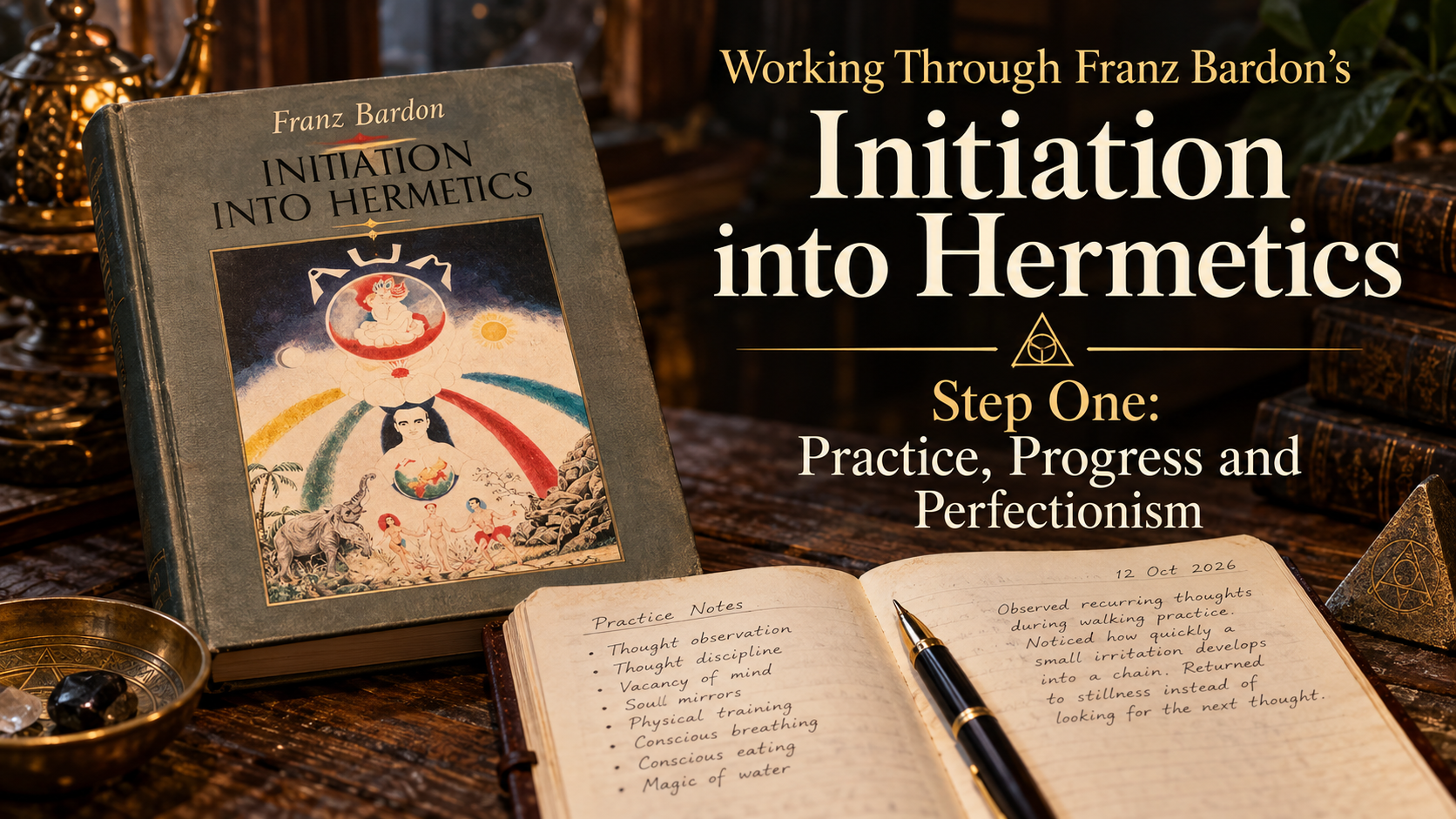

My experiences of Step One, with practical advice and observations from the Perseus community. By James. For your information I started this journey of IIH in 2008, getting into serious practice in 2009.
A surprising number of people spend years working on Step One of Franz Bardon’s Initiation into Hermetics. Some make steady progress and enjoy exploring the exercises in greater depth. Others find themselves repeating the same practices, unsure whether they’ve achieved the necessary standard to move forward.
I was firmly in the second group.
For years, I returned to Step One, largely because of vacancy of mind. I had convinced myself that I needed to achieve something approaching an advanced state of samadhi before I could consider the exercise complete. Looking back, I think I was expecting far too much from what was supposed to be a foundational exercise.
That doesn’t mean Bardon’s standards should be ignored. The exercises build upon one another, and progressing without the necessary foundations is unlikely to end well. But there is a considerable difference between meeting the requirements of an exercise and demanding a level of perfection that was never intended.
Over the years, I’ve trained with Mark Rasmus, studied the methods taught by Bob Smith of Sixty Skills, and learned from other experienced practitioners. Some of that training helped me understand exercises that had puzzled me for years. Other methods showed me that capacities I had struggled to develop could be trained much more efficiently.
This is the first of ten articles on working through Initiation into Hermetics. I’ll be drawing on my own experience, along with things I’ve learned from teachers and other people doing the work.
There’s little point in repeating Bardon’s instructions when you can read them in the book. I’m more interested in what happens when you try the exercises, the difficulties that arise and the ways people have found to get past them.
Not everyone will agree with my approach, and I wouldn’t expect them to. I’m describing what I’ve tried, what has helped and what I’d do differently if I were starting again.
If you’ve been stuck on Step One, I hope some of it saves you time or at least helps with understanding.
Thought Observation: Watching Without Becoming Involved
Thought observation was relatively straightforward for me. I already had experience with Tibetan Buddhist practice, so the basic principle was familiar. I sat, allowed thoughts to arise, and observed them without becoming involved.
That last part is important. A thought might arise about something you need to do tomorrow. There’s nothing particularly interesting about that. But before you know it, you’re planning the day, imagining conversations, anticipating problems and mentally rehearsing solutions. Five minutes have passed, and you’ve forgotten that you were supposed to be observing.
The exercise is to recognise the thought without following it. If we become absorbed in the thought, we recognise what’s happened and return to observing. There’s no need to become frustrated or treat the session as a failure.
Rawn Clark, in A Bardon Companion, describes learning to observe as an uninvolved witness rather than trying to force the mind into a particular state. That made sense to me from my Buddhist practice. My problem wasn’t the appearance of a thought; it was how easily I followed it without noticing. Read Rawn Clark’s Step One commentary.
A Question About Translation
The wording of thought observation in English translations of Initiation into Hermetics can be confusing. Some readers take the reference to a train of thoughts to mean that they should remember the thoughts afterwards, perhaps even reconstruct their sequence.
I’ve never approached the exercise that way. My understanding is that we’re supposed to remain aware of the train of thought as it occurs, without becoming absorbed in it. Maintaining awareness of thoughts is quite different from trying to memorise every thought.
I’ve also come across disagreement about the German wording. A small translation difference can change the exercise considerably, although I wouldn’t call it a translation error without comparing the original and the particular English edition.
When the Mind Seems to Become Busier
Something odd can happen as observation improves. At first we notice the obvious thoughts. Later we begin seeing the fragments, faint associations and emotional movements that were going on unnoticed all along.
The mind can seem busier than before. It may simply be that we’re noticing more of it.
If that happens, it doesn’t necessarily mean the practice is going backwards. More sensitive observation doesn’t always feel like greater stillness.
The Seed Thought
One thing I became particularly interested in was the way a single thought could develop into an entire sequence of associations, emotions and sometimes even bodily reactions. A seemingly insignificant thought might appear, and before long the mind would be heading somewhere I didn’t particularly want it to go.
Occasionally, I noticed an unexpected physical response, such as an urge to sneeze. My impression was almost that the subconscious recognised where the train of thought was heading and was interrupting it. I can’t say exactly what caused those reactions, but they made me pay much closer attention to the relationship between thoughts, emotions and the body.
The more useful discovery was how much happens between the first thought and the eventual reaction. Catch it early and there’s a chance to do something different. That becomes especially relevant when we get to the soul mirrors.
Thought Discipline: Stop, Observe
Thought discipline was another exercise I found familiar from Buddhist practice. The principle is simple enough: when we’re doing something, we should actually be doing it. If we’re washing the dishes, wash the dishes. If we’re walking, walk. If we’re working, pay attention to the work.
Yet most of us spend an enormous amount of time doing one thing physically while thinking about something entirely different. We get into familiar grooves. Sometimes these involve worries or imaginary conversations. Other times they’re pleasant fantasies that we rather enjoy, which makes them even more difficult to interrupt.
Do this often enough and divided attention becomes a habit. We can spend half the day somewhere other than where we actually are.
My approach was simple. When I noticed myself drifting into one of these patterns, I would mentally say, “Stop. Observe.” Then I would return my attention to the task. There’s nothing complicated about this, but it helped interrupt the habit.
There’s nothing wrong with imagination, planning or reflection when that’s what we’ve chosen to do. The difficulty is when the mind goes there of its own accord and we can’t bring it back.
The second part of thought discipline, keeping the mind on a chosen subject, works on that same problem more deliberately. We choose what to think about and stay with it.
Virgil discusses something similar in his chapter on Malkuth in The Covert Side of Initiation. Drawing on William Mistele, he writes about paying attention while cooking, talking, driving or training. It’s easy to be attentive in a quiet room and lose that attention as soon as we’re doing something ordinary. Read Virgil’s chapter.
Mouni Sadhu’s Clock Exercise
Mouni Sadhu gives a useful concentration exercise in Concentration: A Guide to Mental Mastery. It’s simple, but not necessarily easy.
You place a clock or watch with a visible second hand in front of you and concentrate on the tip of the moving hand. The objective is to follow it without allowing your attention to wander. You’re not thinking about the clock, the numbers or how much time has passed. You’re simply following the movement of the second hand.
When attention wanders, you recognise it. The exercise gives you a fairly clear indication of how long you can maintain uninterrupted concentration. You can then work on gradually extending that period.
The clock makes it quite obvious when you’ve drifted off. You may be surprised at how short your uninterrupted concentration is, but at least you have something definite to train.
Sadhu’s book contains much more than this one exercise, so it’s worth reading his instructions properly. The clock is a useful starting point.
It’s not Bardon’s thought observation or vacancy of mind, and I wouldn’t use it as a substitute. I see it as a way of developing concentration when that particular ability needs work.
Vacancy of Mind: Stop Looking for the Next Thought
This was my biggest obstacle in Step One. For years, I was convinced that I needed to achieve something approaching an advanced meditative absorption before I could move forward. I would practise, fail to reach the state I imagined was necessary, and eventually start again.
I had also misunderstood how the first three mental exercises relate to one another. I was treating them as separate things which yes they are BUT I also see Vacancy as a result of the 3 prior stages of Step 1 Mental. The prior exercises are the cause of being able to enter vacancy.
I also think we need to be practical and balanced about what we expect from Step One. If we interpret vacancy of mind as requiring something approaching deep samadhi or spiritual enlightenment, we are effectively demanding an extraordinary level of attainment at the very beginning of a ten-step system. That seems neither reasonable nor consistent with the idea of progressive training. This isn’t an argument for lowering Bardon’s standards, but for understanding what those standards actually require at each stage. For what is supposed to be a demanding but balanced and reasonable training system for a normal working person, this requirement would simply be unbalanced and not in touch with reality. I do not think Franz Bardon would make such a mistake.
Awareness Can Move Faster Than Vacancy
As observation becomes more sensitive, we start noticing things that were previously too subtle to catch: the beginning of a thought, a faint impression, perhaps something that doesn’t seem to come from our own deliberate thinking. Whatever we make of those experiences, they can present a practical difficulty.
If we continue searching for thoughts, there is always something else to find. In a sense, awareness can move faster than vacancy of mind.
I’d sit down to practise vacancy and spend much of the session waiting for the next thought to appear. But continually checking whether the mind is quiet is another way of keeping attention on mental activity.
What helped was turning towards the stillness instead. Rather than looking for another thought, I stayed with the silence that was already there and allowed myself to settle into it.
Rawn Clark expresses this well in A Bardon Companion. He speaks of attention being “focused instead upon the peaceful silence that exists in the absence of thought.” That is the distinction I missed for years: I was looking for thoughts instead of remaining with the silence. Source: A Bardon Companion.
Building the Battery of the Will
I also find it helpful to think of concentration as building a battery of the will. You don’t begin with a fully developed capacity; you build it through use.
A short period of genuine concentration is something we can repeat, become familiar with and gradually extend. Repeatedly demanding ten minutes when we can barely manage one may only teach us to dread the exercise.
This is another reason I like the clock exercise. It gives us a straightforward way to train attention and see whether it’s improving.
Effort and tension are not the same thing, either. Sometimes determination is needed to remain with an exercise; at other times, the effort of trying to force stillness is the very thing preventing it.
Building Success Instead of Repeating Failure
Mark Rasmus taught me to pay attention to what we’re reinforcing when we practise. His point was that the subconscious is watching, too.
Imagine sitting down every day, attempting ten minutes of vacancy of mind, becoming frustrated because you cannot manage it, and finishing the session convinced you’ve failed. What are you reinforcing?
Repeated sessions like that can make vacancy of mind something we associate with frustration. Mark’s approach is to begin with a period we can actually manage—thirty seconds, perhaps, or a minute—get used to succeeding, and gradually extend it.
That doesn’t lower Bardon’s eventual requirement. It’s a way of working towards it rather than testing ourselves against it day after day.
You can see this in our interview with Jenneke of Exile. Following Mark’s advice, Jenneke began with just two seconds of vacancy and built up through fifteen seconds, thirty seconds and two minutes. Jenneke also describes two parts to the exercise: relaxing into vacancy, which he associates with water, and then applying the will to remain there, which he associates with fire. Entering the state and staying there aren’t necessarily the same skill.
Anna describes a different solution in Beyond Boundaries: A Journey through Mental Discipline, Telepathy, and Hermetic Practice. Thought control and vacancy were among the hardest exercises for her. She used the sound of a ticking clock to train her attention: “At first, I barely managed twenty seconds,” she recalls. She eventually managed a couple of minutes and then returned to vacancy without the clock.
The clock helped her get past a difficulty; she didn’t turn it into a replacement for Bardon’s exercise.
I like having both accounts because they show two ways of dealing with the same problem. Jenneke worked on short, successful periods of vacancy. Anna trained her concentration with a sound and then went back to vacancy. Neither simply sat through the same unsuccessful session indefinitely.
Stillness Has Depth
Mark Rasmus has spoken about different depths of stillness. I wish I’d understood sooner that the vacancy required in Step One is only the beginning of what can be experienced.
At first there’s the effort of not following thoughts. Later the stillness itself becomes something we can explore, with subtler and subtler levels appearing as the practice deepens.
Sometimes the experience changes from holding the stillness to being drawn into it, towards what I can only describe as its centre. I see that as part of a much longer development, potentially leading towards the deeper experiences Bardon associates with Akasha.
That is precisely why I wouldn’t demand those deeper experiences as the entry requirement for Step Two.
I spent years making that mistake.
For anyone wanting to explore this further, I’ve written a separate article, How to Meditate and Enter the Void, which examines several approaches in more detail.
The Soul Mirrors: More Than Making Lists
The soul mirrors became far more interesting to me once I stopped treating them as lists to be completed and started seeing the patterns behind the entries.
The obvious traits were relatively easy to name. Later I began noticing that three or four things I’d written down were sometimes different expressions of the same underlying tendency.
Elemental Classification: It’s Fine to Change Your Mind
My elemental classifications changed as I gained experience. Some traits were easy to place; others could reasonably fit more than one element. I sometimes came back to an entry months later and saw it quite differently.
I’d make the best classification I could at the time, then change it if I learned something new. Spending weeks worrying about the perfect column for every trait isn’t likely to help much.
André Consciência goes further in Considerations and Practices on the Soul Mirror. He asks whether a trait is principally intellectual, emotional or physical, and how these different levels affect one another. That’s a more productive question than arguing endlessly over the elemental label for an adjective. André’s full essay is available here.
An Additional Method: Scoring Intensity
In a private training group I encountered a simple addition: give each characteristic an intensity score from one to three. An occasional irritation isn’t necessarily on the same level as a habit that repeatedly causes serious problems.
The scores can also be entered into Excel or ChatGPT to make a chart of the black and white mirrors and elements. It gives a quick picture of how the traits are distributed across the elements.
Sometimes a particular element stands out, or the difference between strengths and weaknesses becomes easier to see on the chart than in the original lists.
It’s only a picture of our own assessments, of course, not an objective measurement of the soul. I still found the visual comparison helpful.
This is something I picked up in training, not an instruction from Bardon.
Don’t Forget the White Mirror
Initially, I found the black mirror easier. It was straightforward enough to identify faults. But after a while, I lightened up a little and realised I actually had plenty of good qualities as well.
It’s easy to turn the mirrors into a long catalogue of everything we dislike about ourselves. That misses half the exercise.
Anna speaks about this in her interview. She was brought up to value modesty and found it uncomfortable even to acknowledge her own “good points.” That can be just as distorting as refusing to admit a weakness. Read Anna’s interview.
Recognising a Reaction Before It Happens
For me, the most useful result of the mirrors was becoming quicker at noticing a trait as it began to show itself. That sometimes gave me a chance to respond before the familiar reaction took over.
It brought me back to those seed thoughts I mentioned earlier. A small thought or irritation could set off a chain of associations, but now I was more likely to notice the beginning rather than only the aftermath.
The earlier we notice the chain, the more room there is to change our response. Not every habitual reaction disappears at once, but it becomes easier to interrupt one when we recognise how it starts.
Equilibrium and Changing Habits
Bob Smith approaches character change differently. In Sixty Skills he emphasises repeatedly establishing elemental equilibrium rather than relying on the soul-mirror lists. In his Perseus interview, he argues that equilibrium works on the conditions behind our habits, including at the energetic level.
If we keep returning to a balanced state instead of acting out the usual reaction, we’re no longer reinforcing the habit in quite the same way. That can make a difference over time.
I’ve found it more productive to work on that balance than to spend the day fighting everything I dislike about myself. The aim is to change how we actually respond, not simply to suppress a trait for a few minutes.
I still value the mirrors for showing me what needs attention. Bob’s approach has given me another way to work with what I find. The test is whether anything changes in everyday thought and behaviour. Read Bob’s explanation of character development and equilibrium.
André Consciência and the Soul Mirrors
André Consciência has written extensively on the mirrors, including Magic Soul Mirrors and Considerations and Practices on the Soul Mirror.
He begins with sound advice: “Focus on small improvements, every day.” He suggests examining our reactions in everyday life, spending time in nature and looking for the causes behind recurring faults. He also warns against using energy work to cover over problems that haven’t actually been resolved in our behaviour. Read the full essay.
His Soul Mirror Chess develops that idea through a rather unusual exercise. Root faults, secondary reactions and smaller habits are represented by chess pieces, showing how one can support or trigger another. Irritability, for example, might be tied to frustration or an inability to cope with a change of plans. André writes that “every fault still has a positive function hidden in it.” The corresponding white pieces represent virtues that can be developed to change the underlying pattern, rather than just suppressing the obvious symptom. Read Soul Mirror Chess.
What I appreciate about André’s approach is that he does not stop at naming a trait. He suggests looking at whether it operates through thought, emotion or bodily habit, and then doing something appropriate at those different levels. Someone who knows intellectually that a prejudice is unfounded may still react against a group of people. Reading about them is only part of the work; André gives the example of actually entering their community and meeting them. This makes introspection less of a private inventory and more of a change in how we live.
His discussion of the chains between faults is equally practical. If a particular behaviour keeps returning, perhaps we are fighting the final expression rather than the cause. André traces examples in which fear leads to avoidance of truth, then confusion, and eventually attempts to control everything. Another fault may have a different chain. I would rather spend time understanding what sets a reaction in motion than repeatedly write down the same entry in my black mirror.
André also warns against trying to solve every psychological difficulty with energetic work alone. In his view, changing an energetic state is not necessarily the same as resolving the underlying habit, and once the temporary effect wears off the familiar behaviour may return. I think that is an important distinction to remember while exploring equilibrium. The mirrors are supposed to tell us something about our actual conduct, not merely give us one more exercise to complete. Read André’s extended discussion.
Physical Training: Get Mobile, Get Strong
I would give the physical side more attention than it usually gets. We’re potentially setting out on years of mental and energetic training, and I find it strange that we can become so serious about those capacities while neglecting the body that has to carry us through it.
My general advice is simple: Get mobile. Get strong. I maybe biased but I am pretty sure if IIH had been written in another time far more would have been said about the body than simply do some gymnastic morning exercise.
By mobility I don’t just mean flexibility. I mean useful ranges of movement backed by strength and control. Nor does everyone need to become a bodybuilder. I want a body that’s strong, mobile and works well as a whole.
Youth Is in the Legs
There’s a saying that youth is in the legs, and I think there’s something to it. I’ve known people who spent years engaged in seated meditation and retreats who seemed to age quite quickly physically. There may have been many reasons for this, but it made me conscious of the importance of balancing prolonged sitting with movement and strength training.
Strong legs contribute enormously to mobility, balance and general vitality as we get older. More broadly, if we’re developing ourselves on all levels, surely the physical body should be developing alongside everything else.
If we spend a lot of time sitting, it makes sense to balance that with walking, squatting, standing practices or resistance training.
Crystalf has trained in Shaolin Kung Fu, Shuai Jiao and Tai Chi Chuan. In his Perseus interview, he puts the physical priority plainly:
“health IS the most important aspect of the physical body.”
It’s easy to become fascinated by energetic experiences and forget how much harder everything becomes when the body is neglected.
Crystalf goes beyond the usual advice to get a bit of exercise. Drawing on his Chinese martial arts background, he argues that training should address not only conventional muscular fitness but what he understands as the energetic body. He points out that Bardon puts breathing, food impregnation, water practice and work with the life force in the physical section for a reason. I find that a more useful way of thinking about this part of Step One than treating it as a health checklist. Read Crystalf’s interview.
Tendon Training and Energetic Potency
Tendon training, particularly Yijin Jing, has been important to my own energetic development, as has building the ball. They are different practices, but both taught me something about the relationship between the physical body and energetic experience.
In internal training, posture, movement, muscular coordination, connective tissue and awareness are all worked with. Physical conditioning and energetic training aren’t necessarily separate activities.
The Pipeline Analogy
Bob Smith uses the image of the body’s “pipes” in his Perseus interview. Without enough physical conditioning, he argues, we may be able to generate energy mentally but lack the capacity to bring it down strongly into the vital level. That’s one reason body training forms part of Sixty Skills.
Bob isn’t talking about bodybuilding for appearance’s sake. His concern is whether we’ve prepared the body for the kind of work we’re asking it to do. Read Bob’s full interview.
That matches something I’ve noticed in my own training: as the body becomes stronger and better connected, energetic experiences can become much more tangible.
There’s a real difference between a faint sensation that is hard to distinguish from ordinary bodily awareness and an experience that is powerful and unmistakable. Physical training has made a difference for me.
Kettlebells and Vital Energy
With Sifu Mark he introduced the idea of doing physical training or loading the body with for example Kettlebells while holding the vital energy, essentially the mind occupied the field of energy around us rather than being drawn back under tension. So with relaxation and keeping the mind out of the body we can load the body – when the load is removed we find our potential with these energies has sky rocketed. I first saw the potential of this in my first trip in 2012 and have used variations ever since.
For general conditioning, I also rate kettlebells highly. They give you an extraordinary amount of work for the time invested; ten minutes can be a substantial session.
Swings alongside a few other kettlebell movements, or combined with press-ups and squats, make sense if time is limited. Learn the movements properly first.
Developing the Body’s Lines of Force
Bob’s “pipes” analogy will sound familiar to people who train Chinese internal martial arts, though the names change between systems. We hear about lines of force, lines of jin and the connections through which the body supports and transmits force. We aren’t creating these connections out of nothing. We’re learning to develop and use what is already there.
We all have fascia, tendons and other connective tissues involved in handling mechanical forces. The question is how well we’ve learned to work with those connections. Stretching, twisting, strengthening and loading the body can train our coordination and sensitivity along these lines.
Thomas Myers’ Anatomy Trains maps interconnected myofascial chains through the body. Anyone familiar with internal martial arts will recognise parallels with their emphasis on whole-body structure. A 2016 systematic review found evidence of anatomical continuity and some force transmission along myofascial chains, although how all of this works in living movement is still being studied. I wouldn’t present that research as proof of the traditional energetic explanations; it’s a useful anatomical perspective on why these connections matter.
That’s part of what attracts me to Yijin Jing. Through stretching, twisting and controlled loading, we learn to strengthen the body along its existing lines of force instead of working against them. We also become more sensitive to how those lines respond to relaxation and alignment.
Mǎbù: Think of a Bridge
Mǎbù, or horse stance, is another example. It is often taught as a test of leg endurance: squat low and stay there. But in internal training the structure matters much more than how long you can endure the position.
Think of the arch of a bridge. Its curved structure supports the weight above it. In mǎbù, the inner lines of the legs should form a similar supporting arch through the groin, carrying and supporting the torso above.
This is why the curve matters. We are not trying to create a rigid shape with hard ninety-degree angles or simply hold a squat until the quadriceps become exhausted. The aim is to develop the supporting structure through the inner legs and groin, involving the kuà and dāng.
Someone experienced in this kind of training can often recognise the difference simply by looking at a person’s mǎbù. The question is not how low they can squat or how long they can hold the position, but whether the body has developed the correct supporting structure and upward force.
This is quite different from treating horse stance as an ordinary leg exercise. The longer we work with the position correctly, the more we can notice how the supporting lines connect and what happens when unnecessary tension gets in the way.
So when Bob talks about developing the pipes, this is the kind of physical preparation I have in mind. We strengthen and become sensitive to the connections instead of expecting seated energetic practice to do all the work.
None of this means that a Step One student must first master Yijin Jing, horse stance or kettlebells. I’m describing practices that have been valuable to me.
Conscious Breathing: Pick a Goal and Stick with It
My main advice for conscious breathing is to choose an intention and stay with it. Initially I kept changing mine. I would work on one quality for a while, move to another and wonder why little seemed to change. I noticed more when I committed to the same goal for longer.
If you’re working on patience, for example, why change the intention after a few days? Use it in conscious breathing, eating and the other appropriate exercises, then see whether anything begins to shift in ordinary life.
William Mistele says something interesting in his commentary on Step One’s physical exercises. Rather than wish for a quality we lack, he suggests approaching it as something we can experience now.
He also writes about “taking something ordinary and turning it into a sacred act.” Eating, breathing and washing happen every day. Giving them attention and a deliberate intention changes how we experience them. Read Mistele’s Step One physical commentary.
If you’re cultivating calmness, feel calmness as you practise. If you’re working on confidence, try to experience confidence. Constantly reminding ourselves that we don’t have the desired quality rather defeats the purpose.
I’d judge the results by what happens outside the exercise. Am I more patient? Less easily disturbed? Better able to hold my attention? Those are the changes I’m interested in.
Conscious Eating: Remembering to Practise
Conscious eating used to catch me out for the simple reason that I’d forget to do it. I’d start eating and remember the exercise halfway through the meal, or afterwards.
There’s no need to turn a meal into a ceremony that everyone at the table can see. The practice can remain completely inconspicuous.
The Magic of Water
I treat the magic of water in much the same spirit. It’s another opportunity to work with the same intention I’ve been using in breathing and eating, rather than inventing a new goal for every exercise.
Confidence also changes with practice. Once we’ve noticed a result for ourselves, there’s less temptation to question every detail the next time.
That confidence needs to come from experience, not from persuading ourselves that something happened. Consistent practice gives us more opportunity to notice what changes.
Keeping a Practice Journal
I’d strongly recommend keeping a practice journal. Experiences that seem unforgettable at the time can fade with remarkable speed, rather like dreams. A particular state of stillness or an unusual observation may seem perfectly clear for a few days, yet weeks later the details have disappeared.
Having notes to look back on makes a difference. We can compare sessions, spot patterns and sometimes notice progress we would otherwise have forgotten. They’re also useful when an exercise stops going well: we can look back and see what we were doing when it worked.
Jenneke put it nicely in his Perseus interview: “Our rational minds can be so good at convincing ourselves that we aren’t making progress, and the journal has the receipts to prove otherwise.” That’s exactly why I like having a record. Our impression of how we’re doing can change from one week to the next. Read Jenneke’s interview.
I wouldn’t make the journal into another elaborate exercise. A few notes immediately after practice are often enough. The trick is to write them down before they vanish.
In my earlier article, Why No Progress?, I also suggested using the journal to keep track of our behaviour outside formal sessions: when we become irritable, what sets off a familiar reaction, what keeps happening in particular situations, and what genuinely changes. The important part isn’t filling a page. It’s going back through the notes weekly and monthly. Some patterns only become obvious when we can see several weeks together.
How Long Should Step One Take?
There isn’t one sensible timetable for everyone. People arrive at Bardon with very different backgrounds. Years of meditation may help with the mental work; someone else may be comfortable with energetic training but struggle with introspection.
Even so, if you’re still struggling with Step One after six months, I’d start asking whether you’ve misunderstood an instruction or developed an unhelpful way of practising. I say that as someone who spent years there.
Six months isn’t a deadline. But it is long enough to ask a few questions. Are you practising regularly? What does Bardon actually require here? Have you turned a beginning exercise into a demand for something much more advanced? And are you noticing the progress you have made?
Rawn Clark’s A Bardon Companion is worth consulting when the requirements aren’t clear. His Companions Along the Way video series also works through the exercises, and he later adapted it into the Companions Along the Way workbook. The written commentary, videos and workbook are separate resources.
Rawn distinguishes between meeting an exercise’s initial requirement and continuing to deepen it in later steps. His expectations for early progress are brisk, and I wouldn’t use his timetable as another stick to beat myself with. What I needed to hear, after so long struggling with vacancy, was that the initial exercise wasn’t meant to exhaust everything that could be achieved with it. His Step One commentary can be read here.
The Perfection Trap
Perfectionism can become a bigger obstacle than the exercise itself. I know, because that was my experience with vacancy of mind.
Of course we shouldn’t rush ahead without the necessary ability. But we also need to know what ability the step is actually asking us to develop.
I wrote about this when Foolish Fish reviewed Initiation into Hermetics. I was glad he brought attention to Bardon, even though I disagreed with his reading of the book. Much of the discussion around his review treated Step One as if Bardon were demanding perfection before the student could move on. That has never been how I understood the instructions. Bardon asks us to complete an exercise properly and meet its requirements. Mastery in that sense is not the same thing as being beyond improvement.
I had been making a similar mistake myself, particularly with vacancy of mind. What I was demanding was an advanced experience of meditation rather than the much more modest beginning Bardon actually sets out. It is surprisingly easy to add conditions that are not in the text and then spend years failing to satisfy them.
In that earlier post I also described the messages I receive from students who have built up an impossible idea of what is required. Sometimes they have not read the relevant instruction for years. They remember their interpretation of it, then add things they have heard from other practitioners, forums and videos. Before long they are no longer practising Bardon’s exercise at all. They are attempting something they have assembled themselves, often without realising it. Read my Foolish Fish response.
One example I raised there concerned later visualisation work: Bardon is asking for mental imagery, yet students sometimes wait for something resembling a fully formed apparition before they consider the exercise successful. That misunderstanding can keep someone occupied for years. With Step One, an equally unhelpful version is to confuse vacancy of mind with an exalted state of samadhi. The lesson for me is not to lower the standard, but to know what standard we are actually trying to meet.
Patience Is Not the Same as Stagnation
Virgil addresses this in his chapter on Malkuth from The Covert Side of Initiation, where he quotes William Mistele:
“Life is short. Make every effort not to get bogged down.”
That is worth taking seriously if we’ve been repeating the same exercise for years. Virgil’s discussion is also concerned with maturity—what happens to our character and our ordinary life while we’re busy pursuing magical training.
He describes students putting in more and more hours while neglecting the everyday work of growing up, attending to relationships and becoming more capable. More hours won’t necessarily solve that problem. His discussion of Mistele returns to simple things like cooking, driving and paying attention to what we’re doing. Read Virgil’s discussion in full.
Patience matters, but so does knowing when something isn’t working. After years of getting nowhere with the same approach, another five years of identical practice may not be the answer.
Trying a supplementary method isn’t necessarily abandoning Bardon. The question is whether it helps develop the ability we’re supposed to be training.
Exposure Gives You Data
I’ve come back to one principle again and again:
Perfection gets you nowhere. Exposure to exercises gives you data. Only then can you make meaningful decisions.
I said much the same thing in Why No Progress?: “done is far better than perfect.” I’d rather have a small result I can reproduce and develop than a fine theory about what I might accomplish someday.
Maybe the sessions are too long. Maybe we’re straining, or we’ve misunderstood the instruction. Maybe we simply need more repetition. At least practice gives us something concrete to work with.
Bob makes a similar argument about the value of improving training methods. In his Sixty Skills interview, he compares magical training to sport and engineering, where people keep finding better ways to teach and develop a skill. His objection is to spending years with a method that doesn’t work when a better one is available. Bob’s interview.
Working Alone and Learning from Teachers
I believe Initiation into Hermetics gives us enough to work through the system independently. I also know how much difference a good teacher can make.
For me, being able to speak directly with someone who understood the exercises made a considerable difference. I learned more in a week of training with Mark Rasmus than I had managed to work out through much longer periods of independent practice.
I’ve also seen students make remarkable progress through Bob Smith’s eighteen-month Sixty Skills training, sometimes reaching levels beyond my own experience in a comparatively short time.
No joke.
Good instruction can shorten the time we spend misunderstanding an exercise. That doesn’t make the work easy, but it can stop us wasting years on the wrong problem.
I made this point years ago when writing about why people fail to progress. A good teacher can save us years, but a bad one can cost us years too. What I value is the coaching: someone who can identify a specific problem, show us how to approach it, and let us test the result ourselves. I don’t see a reason to hand over our judgement simply because someone has more experience.
When asking for help, I would give the person teaching me the actual details of my practice—what I tried, for how long and what happened—rather than ask a broad question and expect a useful answer.
Crystalf closes his Perseus interview:
“a master walks his own path”
That’s how I see good teaching. Someone can guide us, but we still have to do the work ourselves.
The Foundations Don’t Disappear
Anna gives a practical example. She was working on Step Eight when we interviewed her, yet she was still doing Step One thought exercises and incorporating food impregnation and water practice into daily life. She hadn’t abandoned the foundations; they’d become part of her routine. Read Anna’s account.
What If You’re Still Stuck?
Imagine someone who’s spent a year on Step One. They’ve made progress, but they still aren’t sure whether their vacancy is good enough. They keep revising the mirrors, reluctant to move forward.
What would I tell them?
I’d first ask whether they’re enjoying it and learning from it. There’s no problem with spending years exploring Step One if that’s what you want to do.
But if you feel stuck and want to progress, go back to Bardon’s requirements. Have you added expectations from later stages? Would a different exercise help with the particular difficulty? Can someone who’s been through it recognise what you’re missing?
Doing the same thing for years isn’t necessarily persistence if nothing is changing.
There are also free courses at Perseus Arcane Academy, including Clint Sabom’s The First 3 Steps of Initiation into Hermetics, plus material on Hermetic fundamentals and movement training.
What Changed for Me
For years I believed I was following Bardon to the letter. I was also worried about moving forward without being certain I could do what was required. Then in 2012 I spent time with Sifu Mark Rasmus. What he showed me produced immediate results. I returned to Initiation into Hermetics with a different understanding of the exercises, not because I’d abandoned Bardon’s system but because I could finally see other ways of developing the abilities it asks for.
That experience changed my attitude to training. I stopped thinking there was virtue in struggling for its own sake. If I can establish vacancy even briefly, I have something I can repeat and extend. If I recognise an irritation before it turns into an argument, the soul mirrors are doing more than giving me a list of faults. In physical practice, the same principle applies: I want to feel and develop the connections I’m training, not merely endure an uncomfortable position and call it progress.
In Why No Progress? I wrote, “Knowing does not equal doing.” I still believe that. We can spend years reading about the exercises, comparing methods and talking about spiritual achievements without developing much ability. Yet putting in the hours is only part of it. We also need to notice whether the exercise is producing the result it should, or whether we have become very good at repeating a misunderstanding.
A good teacher or another practitioner’s account can make a tremendous difference, as I’ve experienced myself. But no one else can tell us whether our practice is changing us if we refuse to look at the evidence. I want to see the results in the meditation, in the body and in the way I behave when things don’t go as planned. The journal helps with that. So does training with people who will tell us when something isn’t working.
I spent too many years assuming that being stuck meant I simply wasn’t trying hard enough. Sometimes more effort is the answer. Sometimes we’re repeating the wrong thing with extraordinary dedication. I wish I’d learned to tell the difference sooner.
With all that said, I hope some of it was useful and I will be back with a walkthrough of my experience in Step 2 soon.

Join the Perseus Community – It is Free!
A Community for Practicing Magicians, Meditators and Internal Martial Artists
Please join us, introduce yourself and begin sharing and learning. We have areas covering all aspects of the esoteric from both Eastern and Western traditions, Energy work and Internal training all freely available on the platform. See you inside.